Call Us
0086-592-6510772Email Us
sunny@qqsmould.com

Call Us
0086-592-6510772Email Us
sunny@qqsmould.com
As we wrap up another busy week here in Xiamen, I've been looking over some of our recent overmolding runs. Whether it's a rugged power tool handle for the construction site or a high-precision medical sensor, overmolding is where material science meets pure mechanical engineering.
A lot of people think overmolding is just about "making a part feel soft." But for our clients like Ikea, Decathlon, and Yeti, it's actually about preventing field failures. If the elastomer peels away from the substrate after three months of use, the product is a failure.
At QQS, we don't just "stick" materials together; we fuse them. Here is how we're handling the technical side of that process right now.
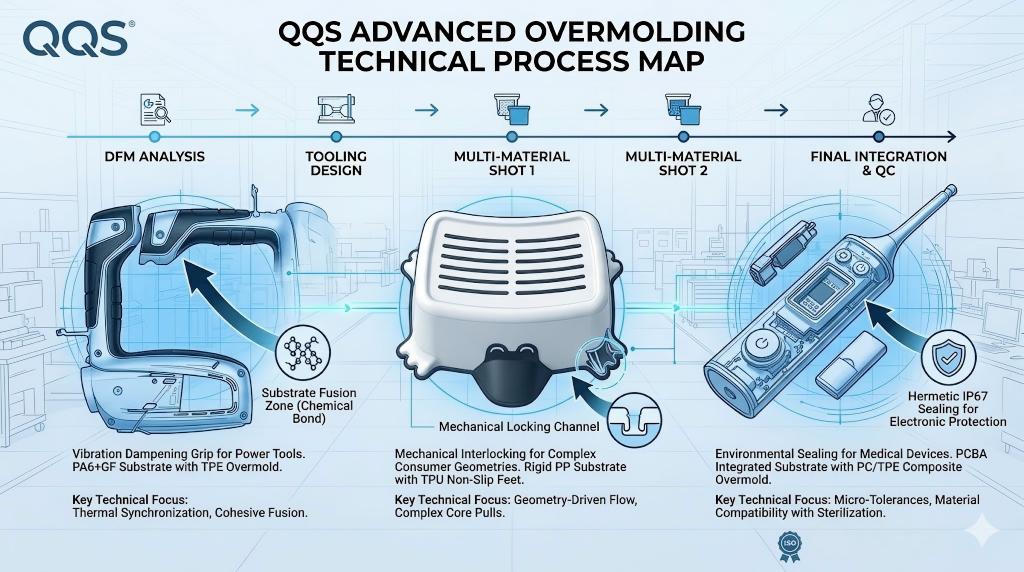
For the power tool housings we produce (like the one in the photo), you're seeing a high-strength PA6+GF substrate fused with a vibration-dampening TPE.
The trick here is the "Heat of Fusion." We time the second shot so that the surface of the yellow substrate re-melts just enough for the molecules to chain together. If the substrate is too cold, you get a "cold joint" and it will eventually peel. If it's too hot, the part deforms. Our engineers spend the first day of every new project fine-tuning these thermal windows to ensure that handle stays permanent for the life of the tool.
Chemical bonding is great, but we don't trust it alone—especially for consumer goods like the frog step stool or heavy-duty outdoor gear for Yeti.
For these projects, we design "Mechanical Interlocks" directly into the tool. We create through-holes and undercuts in the rigid plastic so that when the soft material is injected, it flows through the part and wraps around the back. It's like a rivet made of plastic. Even if the chemical bond were to fail, the soft feet or grips physically cannot fall off. This is the difference between a "cheap" mold and an export-quality mold.
The medical probe is a different beast entirely. Here, the overmolding isn't for grip—it's for a hermetic seal.
Because we have in-house SMT and assembly, we often overmold directly over delicate electronics. The challenge here is "Flash Control." If the pressure is too high, you crush the sensor; if it's too low, the seal isn't waterproof. We use micro-tolerance shut-off surfaces in our molds to ensure the overmold is perfectly flush, creating an IP67-rated barrier that can survive the harsh sterilization cycles required in hospitals.
The reason brands stay with QQS for 10+ years isn't just because we have the machines—it's because we own the whole loop.
When we design the mold, we're already thinking about how it will sit on the SMT line later that afternoon. We handle the DFM, the tool making, the multi-shot molding, and the final QC under one roof. This ends the "blame game" between different suppliers and keeps your project moving.
If you're struggling with material separation or seal failures on your current overmolding project, let's take a look at your DFM. We can usually spot the issue in the gating or the cooling layout within the first hour.