

Call Us
0086-592-6510772Email Us
sunny@qqsmould.com

Call Us
0086-592-6510772Email Us
sunny@qqsmould.com
Many customers believe that once the first sample looks good, the mold is ready for production. In reality, that's only the beginning.
Imagine you've just completed a new injection mold. The first molded part looks exactly like the CAD model—dimensions are within tolerance, the surface finish is excellent, and the customer is pleased.
So, is the mold ready for mass production?
Not necessarily.
At QQS, we've seen projects where the first sample looked perfect, but after a few thousand cycles, problems began to appear: dimensional variation, flash, unstable cycle times, or assembly issues. None of these problems were obvious during the first trial, but all of them could affect production efficiency and product quality.
That's why tooling validation is an essential part of our manufacturing process—not because the mold failed, but because we want to ensure it continues performing consistently long after the first sample is approved.
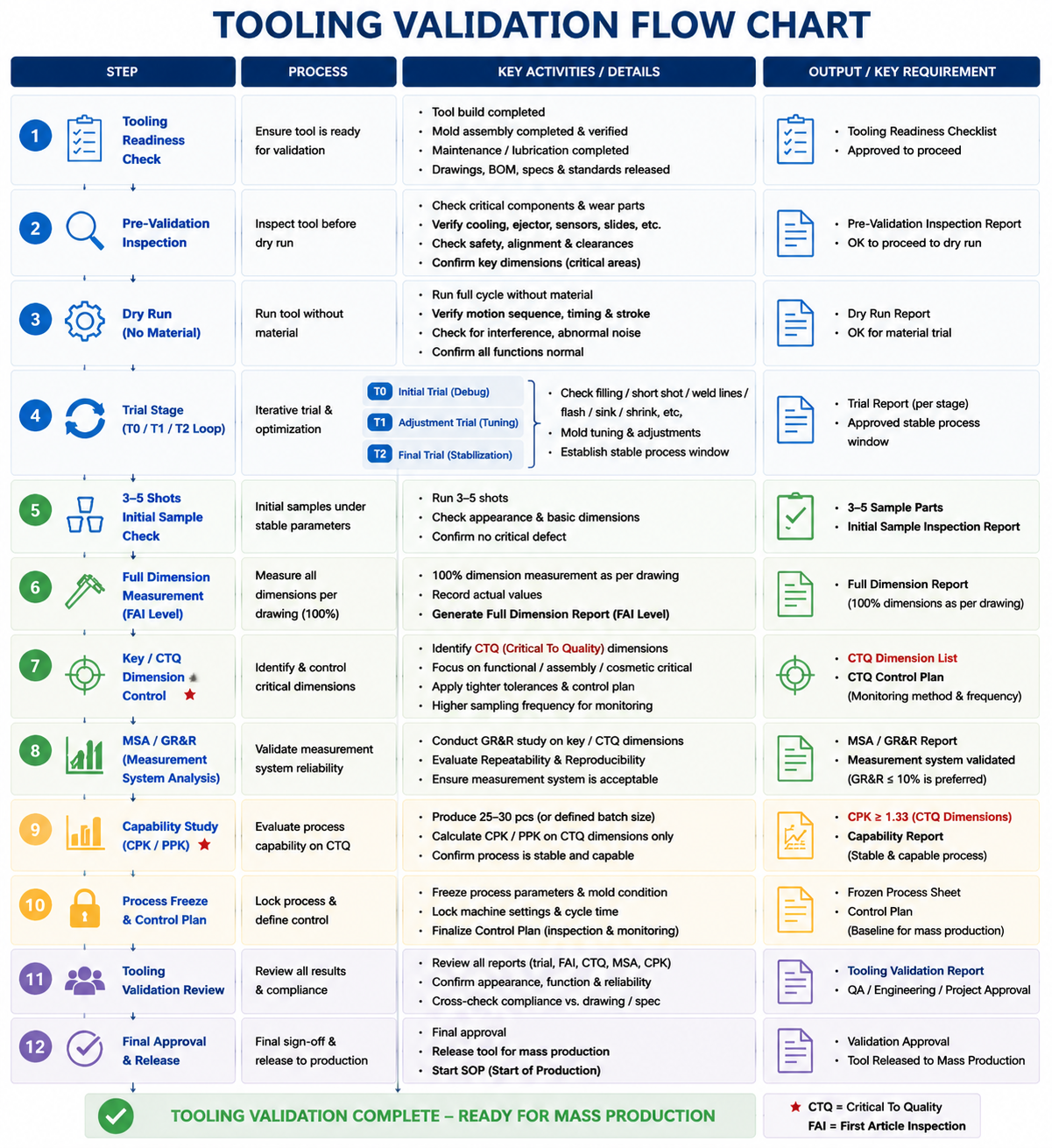
Tooling validation is a systematic engineering process used to confirm that a mold is capable of producing stable, repeatable, and compliant parts under normal production conditions.
Rather than focusing on a single "good sample," tooling validation evaluates the entire manufacturing system, including the mold, machine settings, measurement system, process capability, and product quality.
The objective is simple:
Can this mold produce the same quality part today, next month, and after hundreds of thousands of cycles?
Instead of treating mold trials as isolated events, we follow a structured validation workflow that gradually builds confidence in the tooling.
Before installing the mold, our engineers verify every mechanical system, including cooling circuits, ejector movement, slides, lubrication, and assembly. Starting with a fully inspected tool helps eliminate unnecessary debugging later.
A detailed inspection allows us to identify potential wear points, alignment issues, or dimensional concerns before resin is ever injected.
The mold is cycled without material to verify movement, timing, and safety. Any mechanical interference can be corrected before affecting production.
This is where engineering experience matters.
During T0, we observe how the material actually behaves inside the mold. Issues such as short shots, weld lines, sink marks, or flash provide valuable information for optimization.
By T1 and T2, adjustments to venting, cooling, gates, and processing parameters gradually establish a stable production window.
The goal isn't simply to eliminate defects—it's to create a process that is repeatable.
Once the process becomes stable, quality verification begins.
Every dimension specified on the drawing is measured during First Article Inspection (FAI). More importantly, we identify Critical-to-Quality (CTQ) dimensions—those that directly influence assembly, sealing performance, or product functionality.
These dimensions receive tighter monitoring throughout production.
Many companies stop after dimensional inspection.
We don't.
Reliable manufacturing requires statistical evidence.
That's why we validate the measurement system through MSA (Measurement System Analysis) and evaluate production consistency using CPK/PPK capability studies.
When the data demonstrates that the process is stable, both our engineers and our customers can move into mass production with confidence.
Some people see tooling validation as additional work before production.
We see it as preventive engineering.
A few extra days spent validating a mold can save weeks of production downtime, costly mold modifications, quality claims, or delayed product launches.
In other words, tooling validation is one of the lowest-cost investments in the entire product development process.
At QQS Mould, we don't simply manufacture molds—we engineer production-ready tooling.
Our validation process combines practical manufacturing experience with structured engineering methods, ensuring every mold is ready for stable, long-term production.
Whether we're supporting an OEM customer with an existing design or helping an ODM partner develop a completely new product, our goal remains the same:
Deliver tooling that performs reliably—not just during sampling, but throughout its production life.
