Call Us
0086-592-6510772Email Us
sunny@qqsmould.com

Call Us
0086-592-6510772Email Us
sunny@qqsmould.com
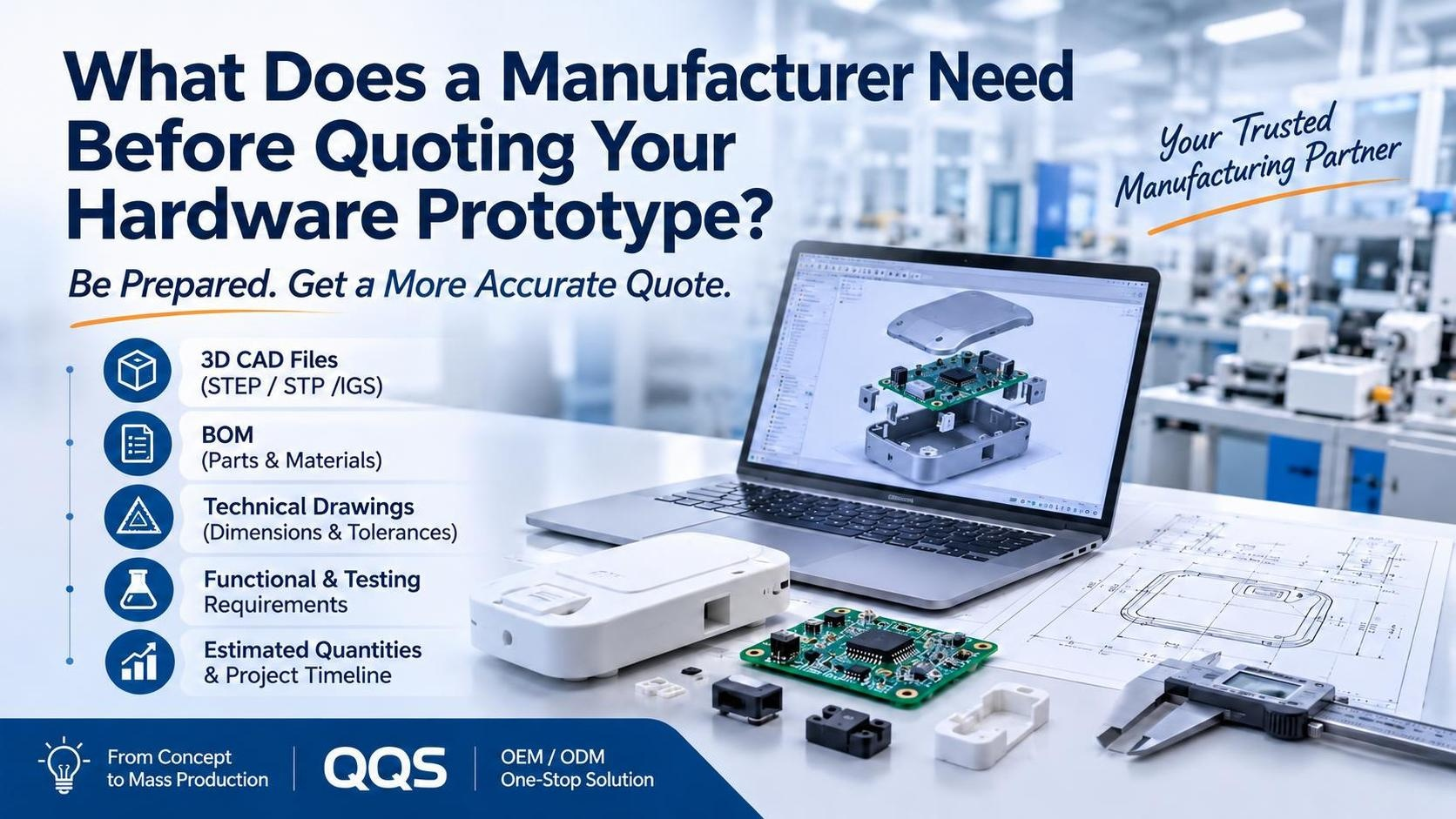
5 Essential Things to Prepare for a More Accurate Manufacturing Quotation
When developing a new hardware product, getting a reliable manufacturing quotation is one of the first important steps. However, many product developers and sourcing managers face the same challenge: they send a 3D model or a brief product description to a manufacturer and expect an accurate quotation in return.
In reality, a 3D model alone is rarely enough.
For products involving plastic injection molding, electronic components, PCBA, and final assembly, manufacturers need a clearer understanding of the product's structure, materials, functions, and production expectations before they can evaluate the project properly.
Incomplete information does not necessarily mean a manufacturer cannot provide an initial estimate. However, it often leads to assumptions, additional clarification, unexpected costs, and potential changes later in the development process.
So, what should you prepare before requesting a hardware prototype manufacturing quotation?
Here are five essential things that can make the process much more efficient.
A 3D CAD model is usually the starting point for evaluating a new hardware product.
It allows engineers to understand the product's overall structure, dimensions, assembly relationships, and potential manufacturing challenges.
For most mechanical and plastic components, we recommend providing 3D files in the following formats:
STEP (.step / .stp): One of the most widely used neutral formats for sharing 3D mechanical models. It is particularly useful for engineering evaluation, DFM analysis, and tooling assessment.
STL (.stl): Commonly used for 3D printing and rapid prototyping. However, it represents the model as a mesh rather than editable CAD geometry, so it is generally less suitable for detailed tooling modifications.
Native CAD files: If available, native files from software such as SolidWorks, Creo, or other CAD platforms can provide additional flexibility for engineering modifications.
For injection-molded parts, a STEP file is generally a good starting point for mold feasibility evaluation.
With a 3D model, engineers can begin checking:
Wall thickness and structural design.
Draft angles and potential undercuts.
Parting line and mold-opening direction.
Potential shrinkage and deformation risks.
Assembly interfaces and component clearances.
A practical tip: If your product consists of multiple components, please provide the complete assembly model whenever possible, rather than sending individual parts separately. Understanding how the components fit together can help identify potential problems much earlier.
A Bill of Materials (BOM) is essential for estimating the manufacturing cost of an electronic or electromechanical product.
It identifies the components, materials, and purchased parts required to manufacture the complete product.
For a typical smart home appliance, the BOM may include:
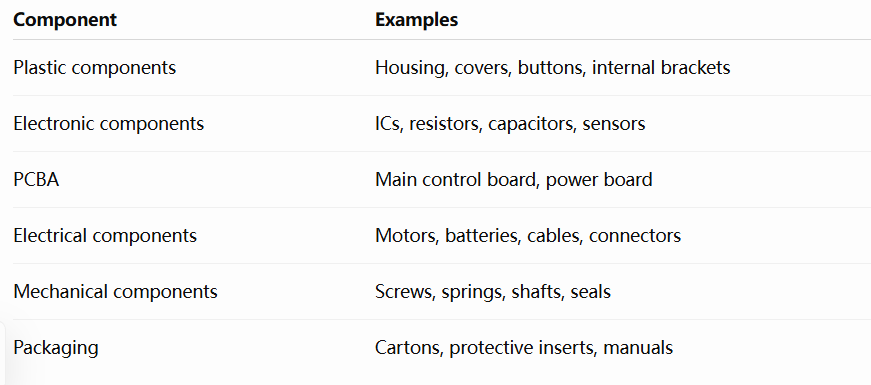
A preliminary BOM does not need to be perfect. Even an estimated component list can help manufacturers understand the product's complexity and identify major cost contributors.
For example, two products may have almost identical external appearances but completely different internal electronics, motors, batteries, or control systems.
Naturally, their manufacturing costs will be very different.
What if the electronic design is not finished yet?
You can still provide a preliminary BOM or block diagram showing the main functional modules. An experienced engineering team can help review the structure and identify the information required for the next development stage.
A 3D model shows the product's geometry, but it does not always communicate every manufacturing requirement.
Technical drawings provide additional information about dimensions, tolerances, materials, surface finishes, and critical assembly interfaces.
For plastic injection-molded components, the following information is particularly important:
Overall and critical dimensions.
Dimensional tolerances.
Plastic material grade and color.
Surface finish and texture requirements.
Critical mating dimensions.
Areas requiring special appearance or cosmetic standards.
For example, specifying ABS is not always enough. Different ABS grades may have different mechanical properties, shrinkage characteristics, and processing requirements.
Similarly, a requirement for a glossy, matte, or textured surface can affect mold design, tooling processes, and manufacturing costs.
If the product includes precision assembly components, it is also important to identify critical dimensions and tolerances rather than applying unnecessarily tight tolerances to every feature.
Our recommendation: Clearly distinguish between critical dimensions and general dimensions. This helps the manufacturer focus engineering attention where it matters most, without creating unnecessary manufacturing costs.
For electronic and smart hardware products, functional requirements are just as important as mechanical design.
A manufacturer needs to understand not only what the product looks like, but also how it is expected to operate.
For example, when developing a smart kitchen appliance, the following information may be required:
Main product functions and operating modes.
Motor speed, power consumption, or operating performance.
Battery capacity and charging requirements.
Control interface and user interaction.
Sensors, connectivity, and communication requirements.
Expected operating life and reliability.
Safety and performance testing requirements.
It is also important to clarify applicable certification and regulatory expectations based on the intended sales markets.
For example, products intended for the European market may require evaluation against applicable CE requirements, while other markets may have different regulatory and testing expectations.
These requirements can influence component selection, PCBA design, enclosure structure, testing procedures, and overall development costs.
One important point: If you already have a product specification or test standard, share it with your manufacturer at the quotation stage. Discovering a special testing requirement after prototype completion can result in additional engineering work and unnecessary delays.
One of the most common misunderstandings in hardware development is treating prototype cost and mass-production cost as the same thing.
They are not.
The manufacturing approach for a prototype may be very different from the approach used for mass production.
For example:
Plastic prototype parts may be produced through 3D printing or CNC machining.
Production parts may require dedicated injection molds.
Small quantities of electronic components may have higher purchasing costs.
PCBA assembly costs can change significantly with production volume.
Manual assembly may be suitable for prototypes but less economical for mass production.
Therefore, manufacturers need to understand your expected quantities and development plans.
When requesting a quotation, try to provide:
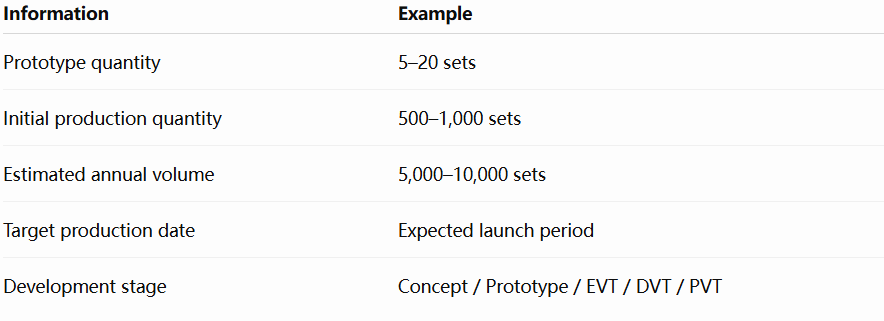
These figures are examples only. Actual quantities should reflect your project.
Even if your initial order is small, providing an estimated annual volume helps manufacturers evaluate material sourcing, tooling investment, production planning, and potential cost optimization.
Think about mass production from the beginning. A product that is easy to prototype is not necessarily easy or economical to manufacture at scale. Early engineering input can help avoid expensive redesigns later.
This is actually quite common, especially for startups, product designers, and companies developing their first hardware product.
You may have a concept, an industrial design, or even a working prototype, but not a complete BOM, detailed engineering drawings, or finalized electronic specifications.
That does not mean you need to wait until everything is finished before contacting a manufacturer.
An experienced OEM/ODM manufacturing partner should be able to support different stages of product development.
Depending on your project requirements, the process may include:
Concept and engineering evaluation: Reviewing the product concept, requirements, and preliminary design.
DFM analysis: Evaluating product structure and identifying potential manufacturing issues before tooling.
Prototype development: Producing mechanical samples and functional prototypes for design verification.
Tooling and component manufacturing: Developing injection molds and preparing the required components.
PCBA and electronic integration: Supporting PCB assembly, electronic integration, and functional testing.
Product assembly and mass production: Establishing manufacturing processes and quality control procedures for volume production.
The earlier manufacturing engineers become involved, the more opportunities there are to identify design risks and optimize the product before significant investment is made.
Before contacting a manufacturer, you can use this checklist to prepare your initial project information.
Design and Engineering
3D CAD files (STEP / STP / STL)
2D technical drawings, if available
Product structure and assembly information
Materials and Components
Preliminary BOM
Plastic and metal material specifications
Surface finish and appearance requirements
Electronic component specifications, if available
Functions and Testing
Product functional requirements
Performance specifications
Testing and reliability requirements
Applicable certification expectations
Commercial and Production
Prototype quantity
Estimated initial production quantity
Annual volume forecast
Target development and production timeline
Target cost, if available
You do not need to have every item finalized before starting a discussion. Providing as much information as possible will simply help your manufacturing partner evaluate the project more accurately.
At Xiamen Qiqiangsheng Intelligent Technology Co., Ltd. (QQS), we understand that successful hardware development requires more than simply producing individual components.
Since 2004, our team has been supporting customers with mold engineering, precision plastic injection molding, electronic manufacturing, and integrated product assembly.
Our capabilities cover the major stages of hardware product development and manufacturing:
Product Development and DFM: Engineering evaluation, structural optimization, and manufacturing feasibility analysis.
Precision Injection Mold Manufacturing: Mold design, tooling development, and mold validation.
Plastic Injection Molding: Manufacturing of precision plastic components for various applications.
PCBA and SMT: Electronic manufacturing and integration support.
Product Assembly and Testing: Component integration, functional verification, and final product manufacturing.
Whether you are developing a new smart home appliance, an electronic consumer product, or a plastic product requiring precision tooling, our team can support your project from early engineering discussions through prototype development and mass production.
We believe that good manufacturing starts with good engineering communication.
Planning a new hardware product?
Send us your 3D files, preliminary BOM, product requirements, or even an initial concept. Our team can review the available information and discuss the most suitable development and manufacturing approach for your project.
QQS – From Concept to Mass Production.